This short story is from The 1950s Nostalgic Collection of Short Stories for Seniors by Bradley Windrow. It’s perfect for older adults—including those with dementia—thanks to its gentle pace and clear storytelling. Be sure to read to the end for a special surprise and discover more free short story for seniors online to enjoy anytime.
Alone, we can do so little; together, we can do so much. –Helen Keller
The first thing that hits you when you think back to the smog in London during December of 1952 is the color. Or, should I say, the lack of it? Imagine an entire city shrouded in gray. The kind of gray that makes you feel like you’re walking through a fog made entirely of disappointment and missed opportunities. You couldn’t see much of the sky and couldn’t breathe without feeling like you were chewing on cotton wool. People were getting sick, and it felt like the whole world had been painted with the same dull brush, a constant reminder that you couldn’t run from it.
I was just a young boy then, barely in my twenties, volunteering with my neighbors to try and make a difference. And when I say “make a difference,” I mean stumbling around the streets, trying not to get lost in the haze while handing out masks like they were going out of style.
Back then, the heart of our neighborhood wasn’t in the post office or the corner shop. No, it was in the slightly intimidating, yet always reliable, figure of Mr. Collins, a 75-year-old retired police officer. At his age, he was always calm, cool, and collected while guiding everyone through one of the toughest periods in history. Everyone trusted him. Heck, he could’ve told me to jump into the Thames River, and I would’ve asked him, “How far should I swim?” He was a man of action, and when the smog hit, it was no surprise that he was the one who rallied us together to help.
“Right, lads and lasses, let’s keep our heads clear and our hearts even clearer,” he said as he gathered us for the first patrol meeting. “This isn’t just about keeping the air out of our lungs; it’s about keeping hope in our hearts.” Mr. Collins was the kind of guy who made you believe everything he said, even when he wasn’t really saying much.
The plan was simple: patrol the streets, check on our neighbors, especially the elderly and families with young kids, and make sure everyone had the essentials to get by. No one could escape the smog, but maybe we could help people weather it a little better.
I remember that first patrol like it was yesterday. The cold wind whipped around us, and there wasn’t a hint of sunlight in the sky—just that thick, suffocating blanket of gray. I was paired with Mr. Collins. Our first stop was Mrs. Hughes, an elderly widow who lived on the corner. Her small house looked even smaller in the fog, like it might vanish at any moment.
When we knocked, Mrs. Hughes opened the door slowly, eyes wide with surprise. She wasn’t expecting visitors, but when she saw Mr. Collins, her face softened, and she stepped aside to let us in.
“Mr. Collins! How kind of you to come,” she said in a voice that crackled from the cold. We helped her secure blankets over her windows to block out some of the smog. Mrs. Hughes was grateful, but you could see the weariness in her eyes. We noticed she was wheezing a lot, so Mr. Collins showed her a way to wrap a scarf around her nose and mouth so she would not inhale so much at a time. I handed her a bottle of water, and we made sure she had enough food to get by. She was barely able to talk above a whisper, but we could feel how much the visit meant to her.
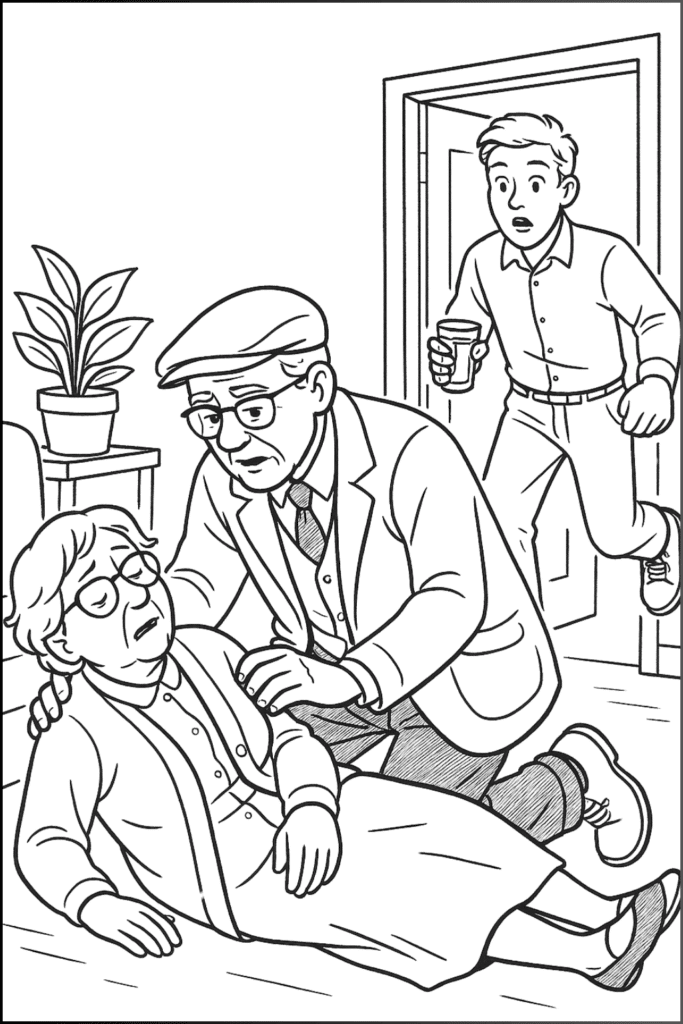
We kept going, checking in with other neighbors. We were visiting Mrs. Wells next, an older woman who lived two blocks over. She had an extensive collection of plants that she was so proud of, but her health had been deteriorating lately. We knocked and waited, but there was no response. Mr. Collins, sensing something was wrong, pushed the door open, and we found her collapsed on the living room floor. I panicked, but he didn’t flinch.
“Quickly, lad, get her some water!” he barked, and without thinking, I rushed to grab a glass. Mr. Collins knelt by her side, gently calling her name. “Mrs. Wells? It’s Mr. Collins. I’m here, love. We’re going to take care of you now.” I handed him the water, feeling helpless. Her breathing was shallow, and she wasn’t responding.
“We’ve got to get her some help. Quickly!” I said.
“No time to waste,” Mr. Collins said firmly. “You run ahead and tell the hospital we need immediate assistance. I’ll stay here with her.”
I sprinted to the nearest phone booth, dialed the hospital’s number, and explained the situation. When I got back, Mrs. Wells had regained consciousness, thanks to Mr. Collins’s calm, steady care. Just as we were waiting for more help to arrive, she gave a weak smile and whispered, “Thank you.”
But then, she said something that made both of us laugh. “I thought I was going towards the light, but it seems it was just all gray.”
Mr. Finch, a local nurse, showed up and had a far more organized approach than we did. She showed Mrs. Wells how to keep the smog out of her home and even gave her medicine. Her calm efficiency was the counterbalance to Mr. Collins’s calm reassurance. Together, we made a good team.
After a few hours, we met up with the others who had been assigned to different areas. We exchanged quick reports and moved on, covering as much ground as possible. The team was growing—neighbors who had never spoken to each other before were now exchanging tips on how to get through the smog together. It was a nice feeling, knowing that despite all the adversity, we were coming together. Sure, we were all cold, tired, and probably a little cranky from the lack of fresh air, but we had each other, and that was something.
One of the most memorable parts of that whole ordeal was when the masks finally came in. A local pharmacist had generously donated a bunch of them, and we went door-to-door, handing them out to anyone who didn’t have one. People’s faces lit up when they saw us coming with those little packets.
When the storm finally passed and the air cleared, it felt like the whole neighborhood came alive again. People stepped out of their homes, blinking in the sunlight as if they’d been in a dark cave for far too long. And then, out of nowhere, Mrs. Hughes—the same woman we had visited first—walked up to Mr. Collins and handed him a scarf she’d knitted herself to show her appreciation.